Care Farming Network recently completed a three-year, $257,753 Research and Education grant from the USDA’s Northeast Sustainable Agriculture Research and Education (SARE) program. This grant allowed us to test and prove that when care farmers are less isolated in their work, both individual farms and the broader movement grow stronger.
What We Set Out to Do
When we applied for this grant in 2023, we recognized that adults with intellectual and developmental disabilities (I/DD) face an employment crisis. Eighty-five percent do not hold a paid job in their community. Yet we know that care farms offer an innovative solution: meaningful work, belonging, identity, and improved well-being for people with I/DD.
We also knew that there was almost no U.S.-based research documenting what made care farms work or why they mattered.This grant allowed CFN to build a regional community of practice and network, conduct much-needed research, and create the infrastructure that care farmers needed.
What We Did
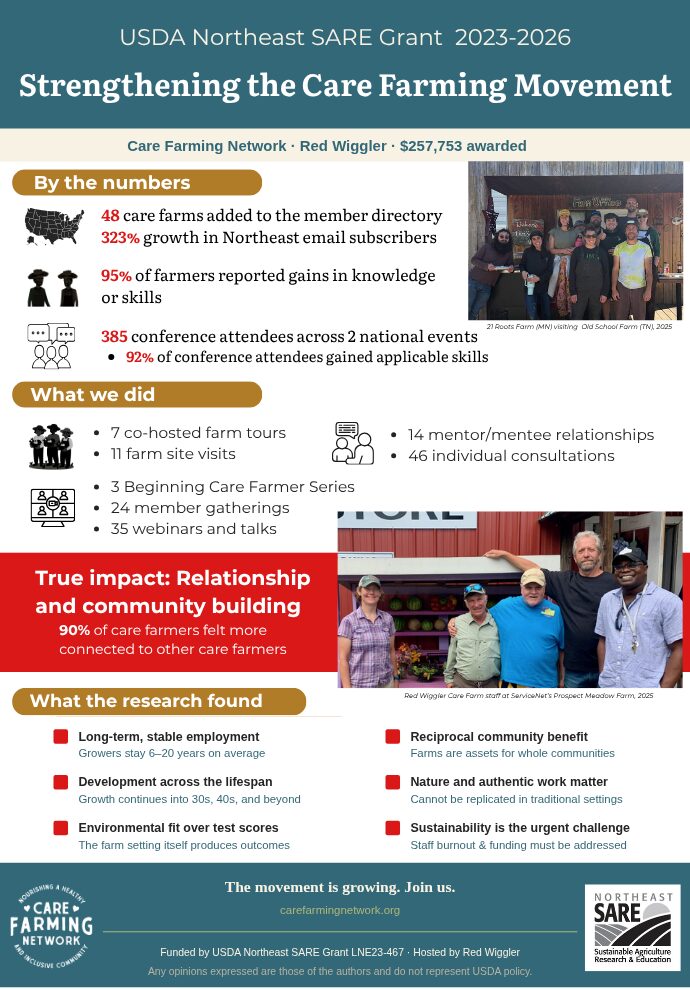
Our original target was to bring 25 care farms into the Network and engage 100 farmers. Here’s what happened:
- 48 care farms in the Northeast were added to CFN’s online map and directory, nearly double our goal
- 40 agricultural service providers joined farmers in the Network, expanding the web of support
- Our Northeast email subscriber list grew 323%
- 95% of farmers who completed evaluations reported gaining knowledge, skills, or awareness
- 90% reported feeling more connected to other care farmers
Over three years, we hosted 24 monthly member gatherings, 35 webinars and conference presentations, 7 farm tours across Maryland, New Jersey, Pennsylvania, and New York, 11 site visits across five states, and 46 individual consultations. We offered our Beginning Care Farming Virtual Series three times, reaching farmers from Maine to Virginia and well beyond. We matched 7 experienced mentors with 7 beginning farmers for a ten-month mentorship program that included farm visits, consultations, and a grant writing workshop.
And we hosted two Care Farming Network National Conferences! At both events, 92% of attendees said they gained knowledge or skills they could apply directly on their farm.
The Research: Building an Evidence Base
One of the most significant and compelling contributions from this grant is the research we conducted.
In Phase One, we surveyed 111 Northeast care farms to collect quantitative data by documenting farm types, business models, infrastructure, staffing, and employment data.
In Phase Two, we conducted in-depth interviews across six care farms, hearing from growers with I/DD, parents, farm staff, volunteers, and community members. Six themes emerged from that research that we believe every person who cares about disability employment should know:
- Care farms provide long-term, stable employment that most other settings do not offer.
- Adults with I/DD continue to develop throughout their lives. Cognitively, socially, emotionally, and vocationally, well into their 30s, 40s, and beyond.
- Environmental fit matters more than measured capability. The most effective care farm staff don’t ask “Can they do it?” They ask “Where do they shine?”
- The farm setting produces outcomes that can’t be replicated elsewhere. Connection to nature, real work, and the natural rhythm of seasons offer powerful benefits.
- The benefits are reciprocal. Care farms create value for everyone: participants, staff, volunteers, and the community.
- Organizational sustainability is the movement’s most urgent challenge. Staff burnout and funding complexity threaten the stability that growers depend on.
This research is now being prepared for publication in peer-reviewed journals, contributing foundational evidence to guide future policy, funding, and field development. This white paper provides a medium-length summary of the findings.
What’s Next
This grant is complete, yet our work continues
Interest in CFN has expanded nationally, with care farmers, social service organizations, and agricultural educators across the country are seeking connection and support. We’ve identified a need to continue building awareness around care farming.
We are actively pursuing funding to sustain and expand the Care Farming Network beyond the Northeast. The relationships, the research, the infrastructure, and the community of practice we built through this grant provide a foundation for us to build on.
To every care farmer who participated in this work, thank you. We also thank the USDA Northeast SARE for providing funding to build the Care Farming Network nationally.
Learn More
Read the final report here.
This white paper summarizes the research findings.
Learn more about Care Farming Network and find resources for beginning and established care farmers at www.CareFarmingNetwork.org.