The following is an excerpt from the Camphill Village Kimberton Hills case study published by Supernuclear. Read the full case study here.
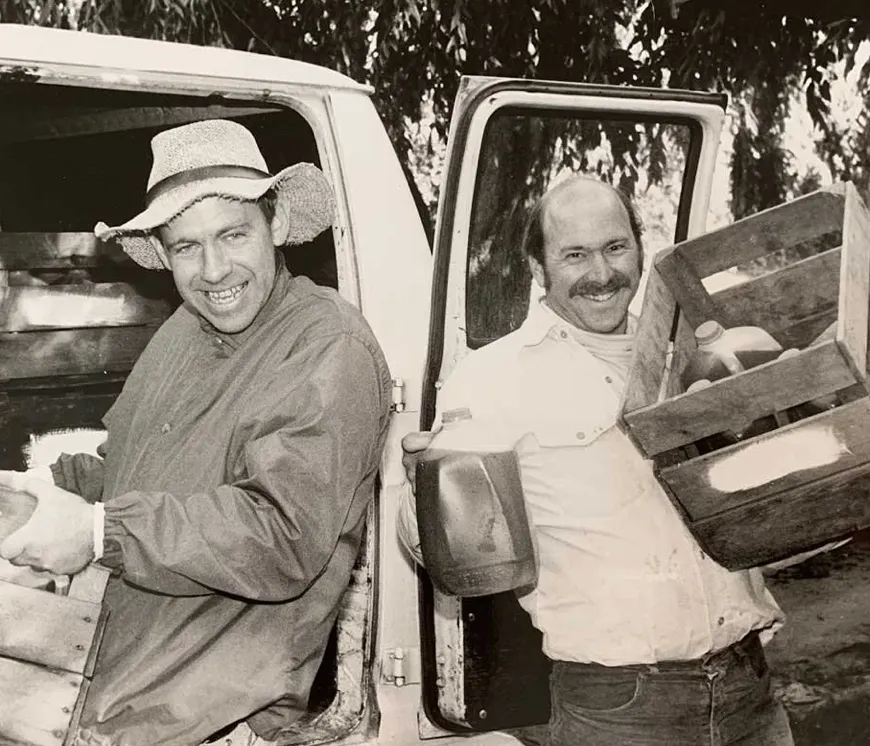
Orchard work in the early years. Bill, to the left, still lives in the village and is now a weaver.
Date founded: 1972
Location: Kimberton, PA (about 45 mins from downtown Philadelphia)
Rented or owned: Owned, thanks to a generous start-up donation
Amount of space: Approximately 120 beds on 432 acres of land
Governance: A consensus-based flat organizational structure, with a mostly hands-off Board of Directors
Origins
We have deep roots, originating in Scotland when people with developmental disabilities were fleeing the Nazi holocaust. The Camphill movement aimed to establish residential communities designed around the needs of adults and children with developmental disabilities, neurodivergence, or other special needs. There are now over 100 Camphill communities on five continents, although some no longer “lifeshare” (more on that below) but employ staff who live outside and draw wages. Some who join us have interests in a philosophy called anthroposophy, derived from the idea of Rudolf Steiner (Waldorf schools are another example of Steiner-influenced ideas). But no religious or philosophical affiliation is required.
Our own community began in 1972 as an offshoot of Camphill USA in Copake, NY. The last of our founders retired just last year, in her 90s, but stories of the early days still abound. We have grown considerably over the decades, but we have also made choices to limit our growth. We do not aspire to become large.
We now have about 15 co-housing houses, ranging from 2 to 13 residents, but we function very much as a village with much movement between the houses for meals, work, etc. We have a mixture of old houses (some over 250 years old) and purpose-built houses, farm buildings, agricultural and pastoral land, an orchard, woods, and even an in-ground swimming pool. Our workshops include a bakery, cafe, pottery, weavery, woodshop, mosaics studio and fiber arts studio, and a number of agricultural work areas. We host a CSA (community-supported agriculture) collective for the village and neighbors and run a dairy that sells raw milk and cheese.