
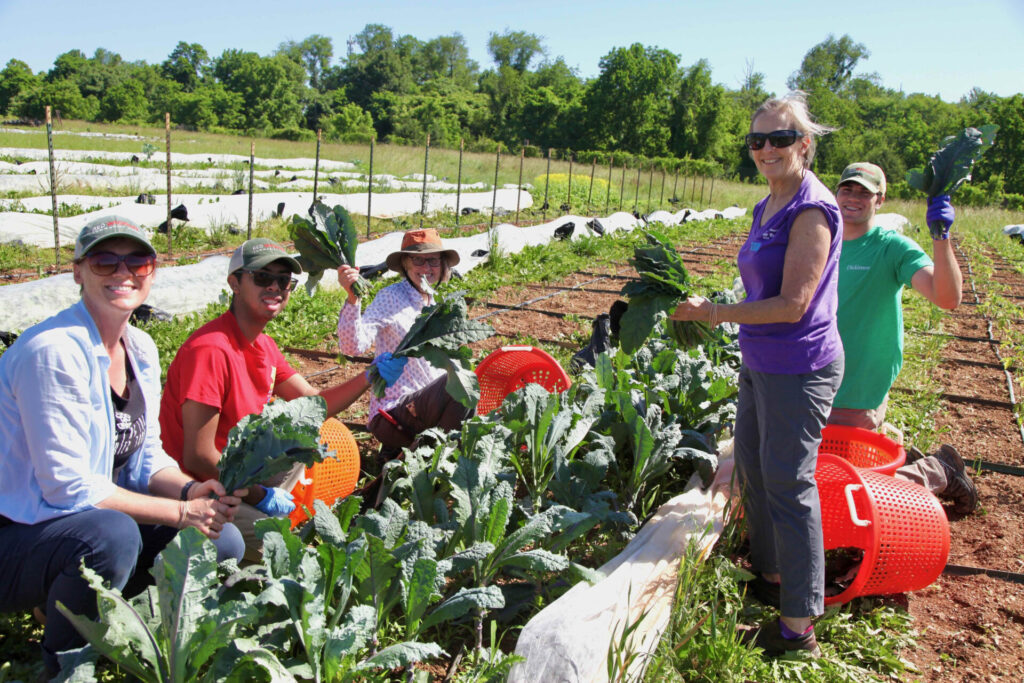
Last September, a group of kids came with their families to the Red Wiggler farm in Clarksburg, MD. Since June and until the end of the growing season in November, they have been receiving food shares from the farm through a partnership with a local food bank as part of a farm-to-school program. This trip was a special treat for everyone in their family, from toddlers to grandparents, to see where their food comes from. As soon as they arrived, a worker welcomed them into the field. They explored together and picked their own cilantro and flowers to take home. Then they sat for hours having lunch together, trying different veggies grown on the farm.
For many of these kids and their families, this visit will be the start of a long-term relationship with the farm. That is intentional, says Kara McCall, the farm’s executive director. “Some will come back to volunteer throughout the year as part of their student service learning hours. Families will come back for different events and celebrations. But they all build a connection to this place because they see us as part of their community,” she says.
Red Wiggler is a care farm, a model that uses regular farming activities—like planting, harvesting, and looking after animals—to help people feel healthier, happier, and more connected.
The farm was started in 1996 by Woody Woodroof, a photographer who had worked in group homes for folks with developmental disabilities. There, he saw a need to create spaces where these folks could connect, get better food, and find meaningful jobs. He started by creating a few community gardens at group homes and a composting service. As the need grew, he started the farm to provide full-time employment with fair wages for these folks. Today, the farm employs 17 folks with developmental disabilities.
“Most people have someone in their lives that they know that if they are given the right opportunity, they would thrive,” McCall says. “In the farm, they see and build relationships with folks with disabilities that are in leadership roles, doing meaningful work growing food, and being an active part of the community, not hidden away.”
Red Wiggler is intentional in creating spaces for neighbors to connect with each other in the farm. Aside from their farm-to-school program, they also run other programs that distribute food to local food pantries and invite them to come to the farm to visit. They also run a Community Supported Agriculture (CSA) program that is farm pick-up only. “Many CSAs have shifted to a delivery or pick up at a farmers market model, but we stuck to asking folks to come to the farm because when people come every week, connect, and build relationships with one another and the staff, it builds community.”
McCall says that they have a very high retention rate on their CSA, with some folks having stayed for 29 years since the founding of the farm because they develop deep relationships with neighbors they wouldn’t otherwise have. “Last week, one of the CSA assistants was sick. One of our CSA customers came up and asked, ‘Where is Kim?’ She wanted to let her know that at the thrift store they have a huge selection of stuffed animals because she knows she loves them. I don’t think that these two folks would’ve known each other otherwise, but now they have a friendship,” says McCall.
McCall says that even the name of the farm, Red Wiggler, speaks to their ultimate goal of fostering connection and trust. “The Red Wiggler is a type of worm that is the unsung hero of composting,” she says. “They take all these components that are unseen and transform them into nutrients. They make the airways that make the compost thrive. And that is what we are doing here. We are constantly asking ourselves, what do we need to shift to make sure everyone who walks in here feels like they belong?”
You can learn more about Red Wiggler on their website. You can also hear from one of their growers here.